Artists and historians will be exploring the Tame and the area around, and the individual journeys through Witton and Perry Barr of residents past and present. There will be lots going on, including events, workshops, printed work and exhibitions for the whole community to get involved in.
Showing posts with label History of Witton. Show all posts

Friday, 20 March 2015

Salford and Spaghetti

The caves on the River Tame, also known as the Dwarf-holes, c. 1895 by Benjamin Stone.
The caves were removed in the 1960s when Spaghetti Junction was built. 

Salford is an ancient crossing of the River Tame which is situated almost immediately under Spaghetti Junction. The word ‘ford’ means crossing and the word ‘sal’ has been transformed from ‘scraet’ or ‘scraf’ meaning caves, and there were indeed caves here until Spaghetti Junction was built (see image above). So this is the crossing by the caves; the caves were first mentioned in the late 1400s, and at the time were called ‘Dwerffeholes’. There is also a brook that joins the river here called Hawthorn Brook, which is difficult to find as it now mainly flows underground, but traces of it can be discovered along the Tame Valley canal nearby. Hawthorn was a healing tree in ancient traditions, so the caves could possibly have had a mystical purpose with people leaving tokens inside, but their original use is long forgotten, so this is just speculation. What is known is that the caves were used in World War II to shelter from bombing, and the area around was heavily bombed due to the many industries all around that made weaponry and machinery.

The reason that there was a crossing here was that the ground was gravelly, which made it easier for horses and carts to get across the river, and the gravelly nature of the ground is why the nearby area is called Gravelly Hill. Eventually a wooden bridge was built, first mentioned in 1290; in 1538 a traveller called John Leland noted that a new stone bridge had been erected; he states: “A mile beyond Bremischam [Birmingham] I passyd over Sharford-bridge of 4. arches of stone. Tame river goythe under this bridge […]. There be faire medows about Sharford-bridge”. The scene today, with the long concrete legs of Spaghetti Junction towering up to the curving roads, is a long way off the ‘fair meadows’ of the 1500s.

This bridge was abandoned over 200 years ago and a new one was built a little further downstream, and called Salford Bridge. The old bridge, neglected, slowly crumbled away, and anything that may have remained, would have been removed when Spaghetti Junction was built.

Spaghetti Junction being built in the late 1960s.
The River Tame is just visible to the right.

The old Salford or Scraford is today where Spaghetti Junction rises, which is the nickname for what is formally called the Gravelly Hill Interchange. It was opened on 24th May 1972 and is a complex entwining of roads, so much so that one of the men who helped build it, Les Smith, got lost when he first used it! Les is very proud as being part of the building of Spaghetti Junction: “It was something brand new, it was like giving you a Christmas present….you know you are building something that is going to be worthwhile…..it’s world famous now, I mean, you see it on the television…..something I can pass down to my children…..grandchildren”. He also remembers how they tried to divert the River Tame, but that it “didn’t want to be diverted, it broke its bank a few times, went back to its original form”.

As you walk near Spaghetti Junction you will notice a lake on the other side of the River Tame, known as Salford Lake. This is possibly the oldest reservoir for drinking water built in Great Britain, and was part of the Birmingham Street Commissioners proposals to get clean drinking water into Birmingham in the 1830s. Both the River Tame and Hawthorn Brook were utilised, and further north the lake in Brookvale Park and Upper Witton Lake are traces of the scheme along the Hawthorn Brook. Many years ago Salford Lake was used for motorboat racing, and the park around for an annual festival with rides and fireworks.

A brand new Spaghetti Junction in the early 1970s. 

Monday, 17 November 2014

Holford and Holford Mill

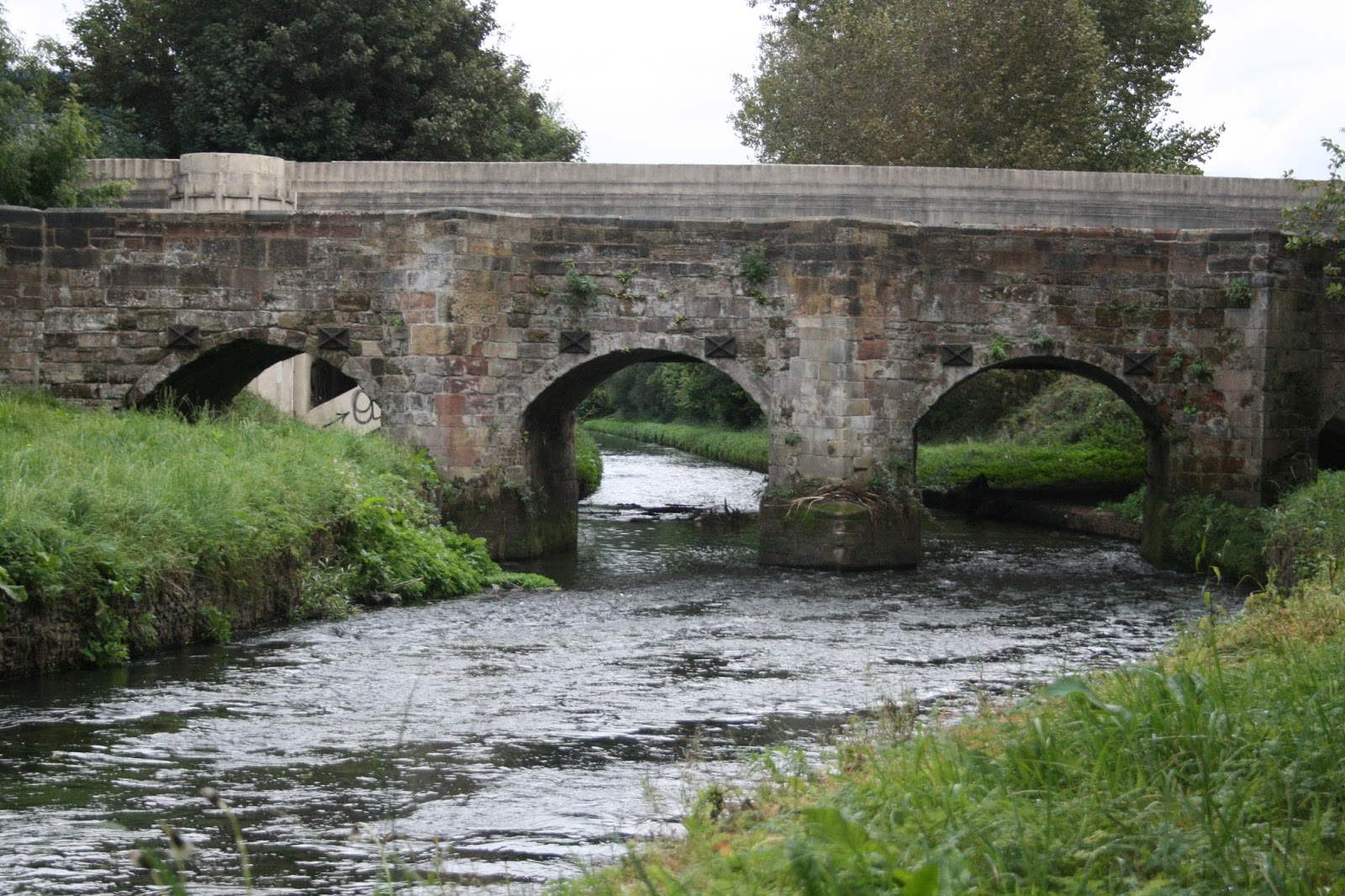
The River Tame in Holford, in the heart of industrial Witton (2014).
Holford Industrial Estate stands on both banks.

Following out 'Ramble & Babble' last Wednesday, some questions about the history of places along the Tame came up......I will, in the next few posts, attempt to answer them.

#1. What is the 'Holford' part in Holford Industrial Estate ?

The Holford area of Witton, where the Holford Industrial Estate stands today, has a long history relating to an ancient crossing (the meaning of the word 'ford' is crossing point) of the river Tame. The 'hol-ford' was probably at Perry Bridges, where the Holbrook joins the Tame, as this was a prominent crossing point dating back to Roman times. The 'hol' part of the name probably relates to the word holm which is a water meadow,* so Holford was the crossing near the water meadows.


Perry Bridges, two bridges on the Aldridge Road, the closer dating from 1711.


EARLY HISTORY
The water of the river Tame in Holford was used to power a mill from, at least, 1228, when a document of "William le Holdere of Honesworth", or, William the holder of Handsworth, notes a highway towards the mill of Holford. It is thought that this was a fulling mill used for hammering wool to remove wool and dirt, so there would have been sheep farming nearby. Like many mills along the River Tame, it was converted in the 1500s from a fulling mill  to a hammer mill, hammering iron to remove the carbon and strengthen the metal; this had happened quite early at Holford, at least by 1533.** By the 1650s the site had been converted to a blade mill, grinding edge tools such as scythes, swords and axes.

METAL ROLLING
Between 1765 and 1781 Matthew Boulton of the Soho Works rented Holford Mill for metal rolling,*3* but it is likely that it was occupied with a dual purpose, with the water-power still being used for grinding tools as well. By 1815 it had been taken over by Thomas Wilmore of Birmingham, a 'manufacturer of rolled, plated, gilding and dipping metal, wires etc.'*4*

THE MANUFACTURE OF AMMUNITION
In the early 1870s the mill was acquired by Westley Richards, an old Birmingham gun making company, and Holford was used as they began in the production of ammunition. This was short lived, and throughout the Victorian period Holford Mill passed through a number of hands, but all the time producing ammunition for sport and for the wars of the period. By 1910 the site was neglected and run down, so was taken over by the neighbouring Kynoch ammunition factory, and became part of that vast site. The actual mill, a two-storied brick building, was being used as an office and store in the 1950s, though the waterwheel itself had been removed.

Advert for the National Arms & Ammunition Co. at Holford, 1873.


A Grenfell & Accles Ltd. exhibition, 1891.

Advert for Grenfell & Accles Ltd, 1890s.
Part of Holford in 1947, with the Tame still separated into two branches.
The closer one was the millrace used to power the original mill. 

NOTES
* Victoria County History- http://billdargue.jimdo.com/placenames-gazetteer-a-to-y/places-h/holford/
** The Tame Mills of Staffordshire, D. Dilworth
*3* Matthew Boulton: Enterprising Industrialist of the Enlightenment, edited by Mr Kenneth Quickenden, Ms Sally Baggott, Dr Malcolm Dick
*4* Wrightson's Triennial Directory (1815)

Friday, 4 April 2014

Upstream:Downstream (Part One- Holford Bridge)


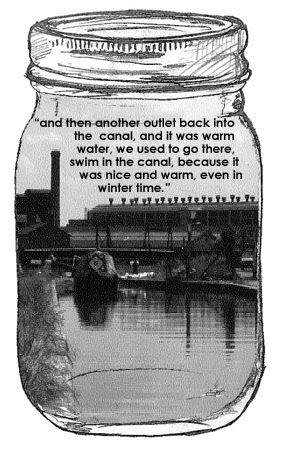
Over April there is a piece of work (that will be added to over the month) on both Holford and Witton Bridges. The work on Holford Bridge explores the history of life along the River Tame; the UPSTREAM side looks at the places along the way to Witton from the river's source, the DOWNSTREAM side explores Witton's industrial history which sat along the Tame as the river flows through towards the Trent and the ocean.

Each jam jar contains a memory and photograph collected from along the Tame.


Tuesday, 5 November 2013

Witton Half Term Trail

Thank you to everyone who took part in the Witton Trail this half term, I have collected the trails and will announce the winner soon.
Lots of jam jars full of Witton and River Tame wildlife (including Witton's industrial wildlife, like cars, bikes, cogs and engines) were placed round the streets over half term. Those that took part in the trail followed the clues on their sheets and could discover what the area used to be like, some hidden places in the present, and produce some ideas for what they would like to see happening in the area in the future.
A map was provided with the trail to help people find their way round.


A little more information about parts of the trail.

Why is there a horse in Witton?

Well, horses used to pull carts, you can see some pictures of horses pulling the milk carts in Tame Road here. But, as well as the carts, horses used to pull the canal boats along the canal, as you can see below; the trail took you the part of the canal in the photo, along the Deykin Avenue cul-de-sac, and the house on the right is still there. It used to be the house for the toll keeper, who collected money from those using the canal.
There was also a cow along the trail, where Witton Farm used to be; now this is part of DANA. Near to DANA those on the trail found out where children, who are now in their 90s, used to pick blackberries in the autumn, and the noises that all the metal manufactories used to make.


PRESENT WITTON


 Gears

Around Electric Avenue and Tame Road there were lots of clues about all of Witton's industry; WILD makes parts which can be found in most people's cars, plus bikes, engines and all sorts of other things are still made in the area. Many of Witton's items travel all across the country and to the rest of the world, like Germany, Turkey, Pakistan, India, Brazil, China and many other places.

FUTURE WITTON

There were some great drawings produced for how Witton could be added to, and how some of the empty buildings and spaces could be used.

I will add these to some separate posts as they were so good.

Monday, 10 June 2013

The Witton Lions


The Onion Fair Escapee
From the late 1800s to the early 1900s it was common for travelling circus's to keep a wide range of animals, including elephants, tigers, bears, and, indeed, lions. The Onion Fair came several times a year to the Serpentine between Aston and Witton, and one year in the 1920s the lion escaped. Here are some memories of the event.....

#1. Hardly had they got to the fair, then pandemonium broke out.

I have a tale to tell (from the 1920s). My mother was persuaded by her mother in law, my grandma, to go with her to the fair. Now my grandma was as round as she was tall, according to my mom. So it was with some trepidation that they started out. My gran used to like a tipple, and my mom was worried that once they had been to the fair, she would want to call in all the pubs on the way home which was Tower Road Aston. How wrong could she have been?

This was before I was born, so I am relaying my mom’s story. It seems that hardly had they got to the fair, then pandemonium broke out, and everybody started running towards them, picture the scene, one very frightened little woman (my mom) and one very old lady, who could hardly put one foot in front of the other, a weight watchers nightmare, so they turned and ran leading the panicking crowd. And it would seem that most of the crowd overtook them, and then with one voice and accord turned back on my mom and gran, as the poor old lion by this time had beaten the crowd and was now chasing them in the opposite direction.

That night was certainly ingrained in mother's memory, and it was probably the only anecdote that she ever told with any certainty.


#2. The greatest thrill was when the lion escaped.

I can only go back to what I remember from 1922, and before that what my parents told me.

We lived a stone's throw from the Serpentine Ground which held the annual Onion Fair, and I can remember when its lighting was by naphtha flares, it was one of Aston's traditions, it belonged to Aston and they came from all over Birmingham to enjoy all the fun of the fair.

It fascinated me as a child, and race down there, and I became a stooge, Charlie Hickman had a boxing booth and he would call me onto the front stage outside the booth and pretend to cut a potato in half with a great cutlass, which I held in my hand, of course the potato was already in two but stuck back and I had to put a terror-stricken face on but it was a free entrance. I was stooge to the magician the Great Maskelyn and found out how one was sawed in half.

The greatest thrill was when the lion escaped, all the fair hands rushed to help capture him so we enjoyed a few rides on the roundabouts. Incidentally, they didn't capture the lion, that went into the churchyard, it gave itself up, the poor beast was more frightened than the population, it had got no teeth anyway, and I can remember when the fair came the next year, the trainer's coat was hung up outside the big tent, ripped to ribbons, but it was well known that his claws had been cut and probably the oldest lion in captivity.


#1 by Dot Dodson, #2 is from the Carl Chinn Archive.

The Lion Works
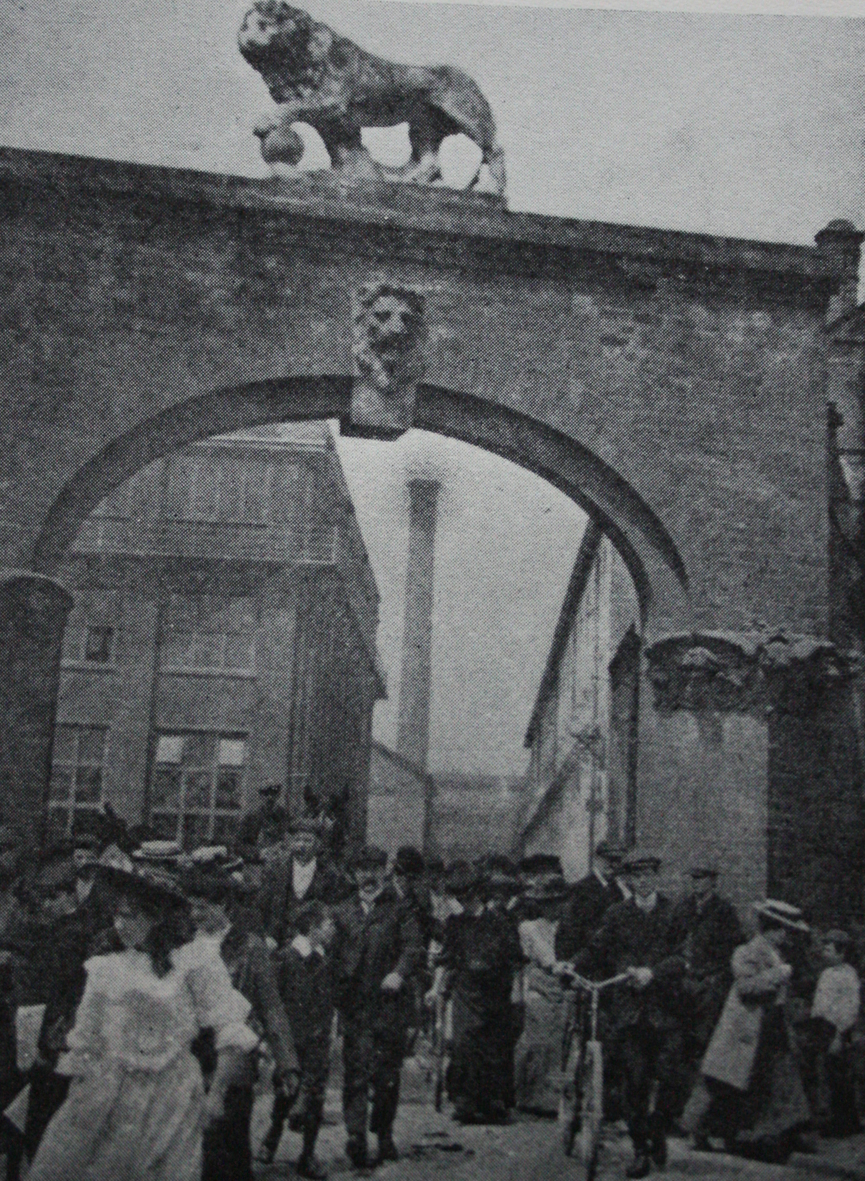
There are more lions attached to Witton as from the 1860s the Lion Works opened by the River Tame, later known as Kynoch's and IMI.


The main gate of the Lion Works was topped with a striding lion with its paw resting on a globe, and a series of other decorative lion motifs beneath. This company was one of the largest in Birmingham, and the country, a real 'lion' of industry at that time.

Aston Villa
The Villa are often called 'The Lions' as well, due to the lion in their emblem; and the gates to the Villa ground are adorned with stone lions too. They have been painted claret, and I have been reliably told (by a staunch Villa fan) that they had to be painted, as before a match between Villa and the Blues the Birmingham fans came and painted all the lions blue. The paintbrush was quickly got out, as was the tin of claret paint!

Thursday, 6 June 2013

All That's Left of Kynoch's and IMI


Whilst walking down Wellhead Lane on Tuesday I came across this tumble-down building and wondered what it could have been, but on a tour of Witton and Aston by an Aston resident (Dave, who has been a really great help with sharing his memories) I found out that this was the rear entrance of Kynoch's. Everyone who remembers Kynoch's tells me that the site was like a town in itself; there was a power station, dentists, doctors, vehicles that never left the site, and each building had bikes to get around because it was so vast. I will put some maps up to show how massive the site was, but for now I will just say that it was big- really, really big.

It seems so strange then that it has all gone, and until I found this building I thought that it had completely disappeared; so this ragged, peeling building is all that is left of what was a company that was world renowned, and supplied the world with its multitude of goods. It seems a shame then, that it is just being left for nature to slowly creep up and help it to finally be unsaveable. So I thought I would take some photographs of the state it can be found in today, with many of the traces of its industrial use, which have a charm of their own. There are more photographs to come.

Monday, 3 June 2013

Why Not Bring Back the Witton News!


Thank you to Fred Brookes for this 1952 copy of the Witton News. The surprising thing is just how many social activities were going on in the area; there were all the social events at the Magnet Club (dances, drama, discussion clubs and children's parties), plus rugby, football, chess, hocky, angling and so many more.

It was very people centred, sharing and celebrating the achievements in the area, as well as weddings and special birthdays. It was issued by the G. E. C. so also talked about the different aspects of that industry too.

It would be great to bring the Witton News back, especially considering that the notable Kynoch Press was situated in Witton as well- a world renowned printing press. The publication could include some of Witton's residents and local heroes, the activities in the area- including those over the next year linked with the flood defences and the Tamed project, some of the areas history and heritage, the memories of local residents, a 'Made in Witton' section, and much more. It could be a real local resource; a modern interpretation for the Witton of today, inspired by the Witton of the past.

I will get cracking! Any suggestions? Please post in the comment below or send me an email.